Everything That Can Go Wrong During a Live Stream (Usually Does) — Here's How the Best Pull It Off Anyway
There's a moment every live stream producer knows intimately. It's about four minutes before you go live, and something — a cable, a feed, a CDN node, a talent's Wi-Fi router — decides it no longer wants to cooperate. The countdown clock doesn't care. The audience doesn't care. You go live anyway and figure it out in real time.
This is the part of live streaming that nobody puts in the highlight reel.
At JNeiPTV, we're all about the live experience — the energy, the unpredictability, the feeling of watching something unfold in real time that you simply can't replicate with on-demand content. But we also have enormous respect for the machinery that makes it happen. So let's talk about what's actually going on behind the stream.
The Infrastructure Nobody Sees (Until It Breaks)
Every successful live stream sits on top of a technical stack that most viewers never think about — and shouldn't have to. But understanding it explains why things go sideways and how the good teams keep it together.
At the core is the encoder: the software or hardware that takes raw video and audio from your source and compresses it into a streamable format. From there, your stream travels through an ingest server — think of it as the loading dock — and gets distributed through a Content Delivery Network, or CDN. The CDN is what allows thousands or millions of people to watch simultaneously without everything melting down. Companies like Akamai, Cloudflare, and AWS CloudFront are doing a lot of the heavy lifting on major broadcasts, even if their names never appear in the credits.
Bitrate management is another constant headache. Stream too high and viewers with slower connections get buffering hell. Stream too low and your picture looks like it was filmed through a screen door. Adaptive bitrate streaming — where the platform automatically adjusts quality based on the viewer's connection — has helped enormously, but it's not magic. During high-traffic events, even the best systems get stressed.
Then there's latency. Standard streaming protocols can introduce anywhere from 5 to 45 seconds of delay between what's happening on camera and what the viewer sees. For pre-recorded content, irrelevant. For live events where audience interaction matters — a concert with real-time fan voting, a live Q&A, a sports broadcast — that lag can completely undermine the experience. Low-latency protocols like WebRTC have improved things, but they come with their own trade-offs in stability and scale.
Real Disasters, Real Lessons
You want war stories? The live streaming world has plenty.
The 2022 Oscars slap heard 'round the world is a masterclass in how live television handles the truly unexpected. The production team had milliseconds to decide whether to cut away, and different international feeds made different calls in real time. The chaos was broadcast to millions — and paradoxically, it became the most-watched Oscars moment in years. Sometimes the disaster is the content.
On the streaming side, Twitch has seen some spectacular technical collapses during high-profile events. The platform's 2020 attempt to host large-scale live concerts during the pandemic lockdowns ran into serious scalability issues, with streams dropping or degrading for significant portions of the audience. The lesson? Stress-testing at projected scale is non-negotiable, and projected scale is almost always an underestimate.
Then there's the infamous Fyre Festival live stream situation — or rather, the complete absence of one. The promotional content promised a glossy, seamless broadcast experience. What actually existed was a skeleton crew with inadequate equipment and zero infrastructure backup. When things fell apart on the ground, there was no technical safety net to catch it. The whole debacle became a cautionary tale taught in media production programs across the country.
On the flip side, the Super Bowl halftime show production team runs what is essentially a military operation. Multiple redundant feeds, dedicated fiber lines, backup encoders on standby, a technical director calling cuts on a board with more options than most people have seen in their lives. When Rihanna performed during Super Bowl LVII in 2023, the technical execution was so smooth that most people had no idea she was performing while visibly pregnant — the real drama was the show itself, not the infrastructure. That's the goal.
What Separates a Great Live Stream from a Disaster
Talk to anyone who's produced a major live stream event and they'll tell you the same thing: redundancy is religion.
Backup encoders. Backup internet connections — ideally on different ISPs running through different physical lines. Backup power. Backup talent audio feeds. Backup everything. The goal isn't to prevent every possible failure; it's to ensure that when something fails (and something always does), there's an immediate fallback that the viewer never notices.
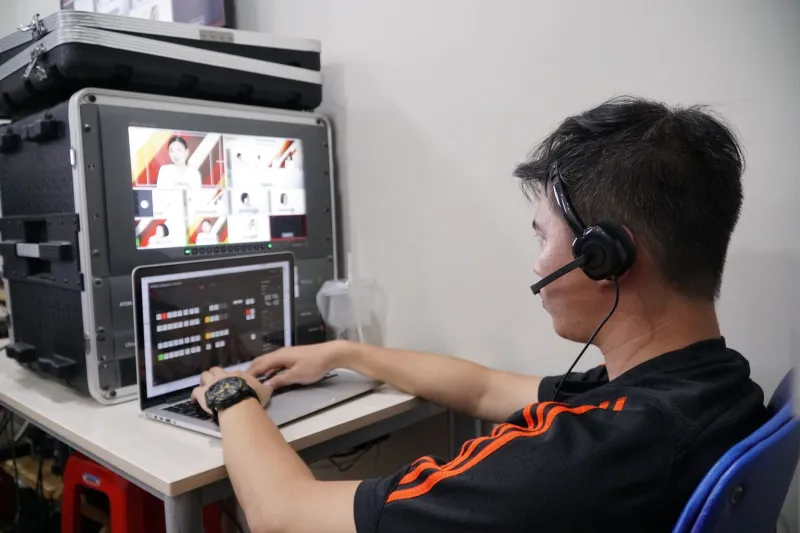
Communication infrastructure is equally critical and often underestimated. A production where the technical director, the floor manager, the graphics operator, and the streaming engineer can't talk to each other clearly is a production waiting to implode. Good intercom systems, clear protocols for calling problems, and a culture where people aren't afraid to flag an issue early — these are the unsexy details that separate professional broadcasts from amateur hour.
Then there's the human element, which no amount of technical preparation fully addresses. Live on-air talent can go off-script, say something that triggers a content moderation crisis, or simply freeze. Unexpected guests can wander into frame. Local news broadcasts have given us decades of legendary bloopers precisely because live TV is genuinely unpredictable. The best producers treat these moments as features, not bugs — they have the instincts to recognize when a spontaneous moment is gold and when it needs to be managed.
The Viral Moment Problem
Here's a wrinkle worth thinking about: in the social media age, the most technically flawless live stream can be completely overshadowed by the one that glitched spectacularly.
A stream that drops for 30 seconds becomes a Twitter conversation. A technical fail that gets clipped and posted to TikTok can generate more engagement than the actual broadcast. This creates a strange incentive landscape for live streaming producers. You absolutely want a clean, professional broadcast. But you're also aware that the chaotic, unscripted moments are often what people remember and share.
The smart play is to build enough technical stability that you have the option to let genuine moments breathe — to not cut away from the unexpected thing happening on camera because you're too busy managing a cascading technical failure. Control the infrastructure so you can afford to let the content be unpredictable.
Why Live Streaming Is Worth the Headache
After all of this — the redundant systems, the disaster scenarios, the latency nightmares — you might wonder why anyone does live streaming at all.
Because nothing else replicates what it feels like to be there. Not an on-demand recording. Not a highlight clip. The shared experience of watching something unfold in real time, alongside an audience that's reacting with you — that's irreplaceable. It's why we built JNeiPTV around the live experience.
The chaos is part of the appeal. The production complexity is the price of admission. And when it all comes together — when the stream is clean, the moment is real, and thousands of people are experiencing it simultaneously — there's genuinely nothing like it in entertainment.
Stream bold, as we like to say. Just make sure your backup encoder is plugged in first.